
1. Policy summary
1.1 Tell us what a better future looks like for you and the people you work with
We want to see a comprehensive bus network connecting rural towns and villages with larger urban centres, and providing every community with a genuinely reliable, convenient and affordable alternative to private car travel for the journeys that people need to make as part of their day to day lives.
1.2 What problem are you trying to solve?
Transport deserts exist where people are severely limited in their ability to connect with friends and family, benefit from employment and education, and access shops and other services. Research has found that across the north east and south west of England, 56% of small rural towns have become transport deserts or are at risk of becoming one. These transport deserts are stark evidence of the failure of our current bus system to meet the needs of rural communities. Following deregulation in the 1985 Transport Act, it has been left to private operators to design and deliver most bus services in England, according to market and commercial imperatives. Dispersed and low population density rural communities have suffered badly under this system, with low commercial viability leading to limited services. This has created a vicious cycle where buses have not conveniently met local people’s needs, causing fewer people to use the buses, and, consequently, further service reductions. Worse still, the cuts to local authority budgets over the past decade have forced councils to reduce their financial support for commercially unviable bus services by 43%. Since it is not currently a statutory duty to provide adequate public transport services, some councils have ended their funding for bus services entirely with more than 3,000 routes closed or reduced. The lack of affordable public transport is also contributing to the serious risk of ‘transport poverty’ in rural communities. Many lower income households in rural areas struggle with transport costs to get to work, training, education, shops and facilities because those costs are a comparatively large proportion of household income, whether spent on public transport or on operating a vehicle for which the running costs can scarcely be afforded. Without reliable and affordable bus services, people are being cut-off from employment and vital services like healthcare.
1.3 What is the solution?
The solution to this problem is to create a comprehensive, convenient and reliable bus network connecting major cities to their satellite communities in the countryside, whole districts to their regional hubs, and all villages of above a certain size into the regional and national public transport system network. This can be achieved by:
- Recognising a universal basic right to public transport and setting a statutory duty for local transport authorities to provide communities of more than two to three hundred residents with a guaranteed minimum of at least hourly services, from 6am to midnight, 7 days a week, with more regular services for larger communities depending on their size.
- Legislating to establish bus regulation under the ‘guiding mind’ of local or regional transport authorities in all areas, with the option for local transport authorities to contract services or to provide them directly so as to reinvest the shareholder dividend savings.
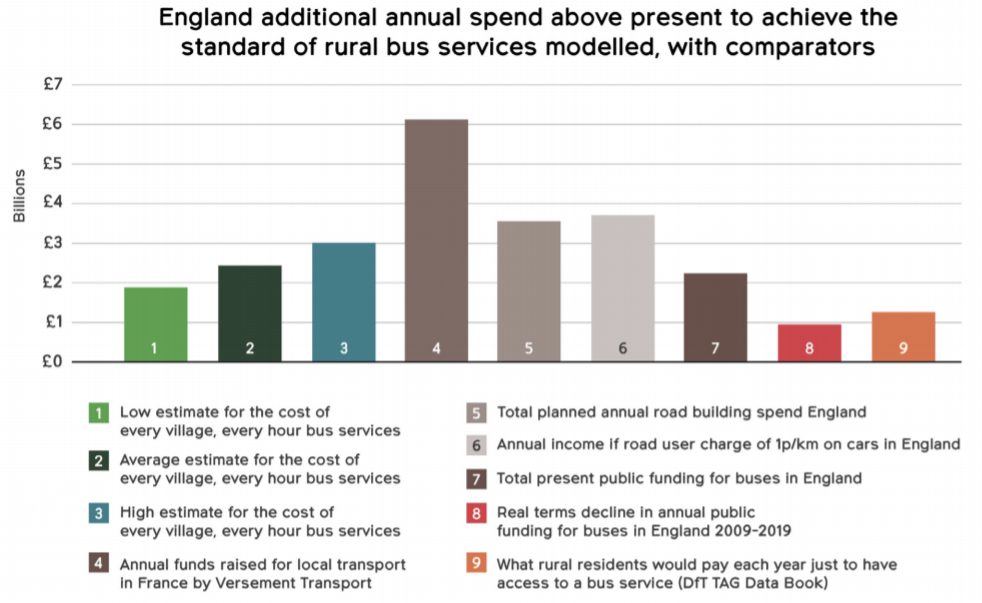
- Establishing guaranteed revenue funding from the national government in the order of £2.7 billion per year to enable local transport authorities to deliver an ‘every village, every hour’ bus network.
- Redirecting funding from current road building schemes to fund the ‘every village, every hour’ network as well as reviewing the range of fundraising powers deployed by local transport authorities in other countries and assess the best ways to enable England’s transport authorities to access similar powers.
- Ensuring that the transformed rural public transport network is affordable or free, for instance through a nationally established £1 flat fare for bus services
- Moving England to a Swiss style single national public transport timetable, aligning all trains and buses on a ‘pulse’ model of repeated hourly services.
*Area of interest this policy proposal relates to: DfT, DEFRA, HMT
2. Background and evidence
For towns and villages to thrive they must be diverse, with residents of all generations and incomes. Bus services that provide frequent links to local destinations and the national public transport network are essential to make this possible. Sadly, rural communities are seeing their youth drain away to reach opportunities they cannot access where they grew up, while simultaneously, older residents’ horizons are shrunk by a transport curfew on their social and economic lives. The requirement for families to own multiple cars to reach their individual jobs risks gentrifying swathes of the countryside by imposing a minimum income threshold for life in villages that already lack affordable housing. Moreover, it is estimated that transport decarbonisation will require traffic levels to fall by up to 60% by 2030. Bus services have a huge role in making this possible by providing an alternative way to travel across all parts of the country.
2.1 Who is primarily affected by this issue?
The inadequacy of rural bus services contributes to traffic that clogs up our roads, limits footfall to struggling high street businesses, and also makes it very hard for people living in urban areas to access and enjoy the countryside. However, those most affected by this issue are those who currently live in rural areas but cannot use a private car. Older people living in the countryside are being cut-off from vital services as well as friends and family, while younger people are struggling to stay connected and reach employment, training and further educational opportunities. For those who cannot afford to own or run a car, living in a transport desert can mean going to work is almost impossible, with the requirement to own multiple cars pushing lower income families into a debt trap, while accessing benefits can mean walking for miles on unsafe roads.
2.2 Describe any relevant context or background to the problem
On 15 March 2021 the government published Bus Back Better: a national bus strategy for England. Bus Back Better is intended to create ‘far reaching change’ with reform of how bus services are planned and delivered. The government has committed a fixed term pot of £3 billion to support the Bus Back Better vision, which falls far short of the £2.7 billion per year funding required to support a comprehensive bus network across the country. In the context of rural bus services, the government’s focus in Bus Back Better and supporting documents is on Demand Responsive Transport (DRT). Whilst DRT has a role to play in connecting the smallest communities to the wider bus network, these services do not support bus patronage equivalent even to the limited number of people that use currently available fixed route services. DRT does not deliver the convenient, regular and reliable services necessary for providing excellent connectivity across rural England. The national bus strategy requires every Local Transport Authority (LTA) to produce a Bus Services Improvement Plan (BSIP) by October 2021, creating tight timelines that risk rushed proposals being developed with inadequate research or public engagement. Since LTA’s do not know how much funding their BSIP will receive, there is also significant uncertainty over how revenue risk will be borne, creating a serious risk that operators will large margins within their costings, making service developments very costly. Moreover, the lack of central government funding commitments beyond the next three years means that LTA’s are likely to be wary of funding being withdrawn and being left with an unaffordable bus network. This means that BSIPs are likely to take a very cautious approach which fall a long way short of the ambitious policies needed.
2.3 How do you know that this is a problem?
In 2020 CPRE published a report on rural transport deserts based on research by the Campaign for Better Transport. This report was the first attempt to apply a consistent method for ranking the availability of public transport in small rural towns. Using data to assess the availability and regularity of bus, rail and other transport services to a nearby major settlement rural towns were allocated a score for their public transport connectivity. These scores allow us to see which towns are severely lacking public transport options, which have limited and likely insufficient services, and which are well connected. In this report, the south west and north east of England were taken as case studies, with 162 small towns across the two regions investigated.
The research showed that the proportion of towns that have become transport deserts or are at risk of becoming one in each county in the south west is as follows: 10 out of 15 towns in Wiltshire, 14 out of 23 towns in Somerset, 14 out of 16 towns in Gloucestershire, 10 out of 14 towns in Dorset, 17 out of 25 towns in Devon, 8 out of 17 towns in Cornwall. The proportion of towns that have become transport deserts or are at risk of becoming one in each county in the north east is as follows: 4 out of 11 towns in Tyne and Wear 2 out of 5 towns in Redcar and Cleveland 6 out of 12 towns in Northumberland 8 out of 22 towns in County Durham.
In total, the research found that more than half the small towns across these areas are transport deserts or are at risk of becoming one.
3. Solution
3.1 Why do you think your solution will work?
Other countries have taken a different approach to the provision of rural bus services. Other prosperous nations have invested in integrated public transport networks delivering minimum service frequency standards to rural communities. The high frequency, regularity and convenience of bus services provided for rural communities in Bern Canton, Zurich Canton and North Hesse would be transformational for towns and villages across England.
The Zurich region of Switzerland covers just over 1700km2 and is home to roughly 1.5 million people, giving it a population density of around 890 people per square kilometre. Across the Zurich region, the transport authority delivers three different levels of service frequency standards to communities of differing sizes. The region guarantees villages of 300 people or more at least an hourly bus service linking them to regional facilities for employment, education, training, shopping and leisure. On routes where multiple communities create stronger demand, the buses run at least every half hour, and four times an hour for towns. These bus services run 7 days a week from 6am to midnight and repeat at hourly (‘clockface’) intervals, connecting passengers smoothly with train timetables.
North Hesse in Germany covers a largely rural region of 7000km2, with one million residents, and a population density of 143 people per square region. North Hesse Verkehrsverbund governs all public transport across the region, with powers to completely design and control the entire network. Despite the highly rural nature of the area, it delivers a network of bus services most of England can only dream of. The Verkehrsverbund has a target of bus services reaching every village across the region every hour. Bus routes currently reach all communities with more than 200-250 residents on at least an hourly basis, and there is a wider ambition to double public transport use by 2030.
3.2 Evidence or data to suggest this policy proposal will be more effective than previous interventions, and supported by stakeholders?
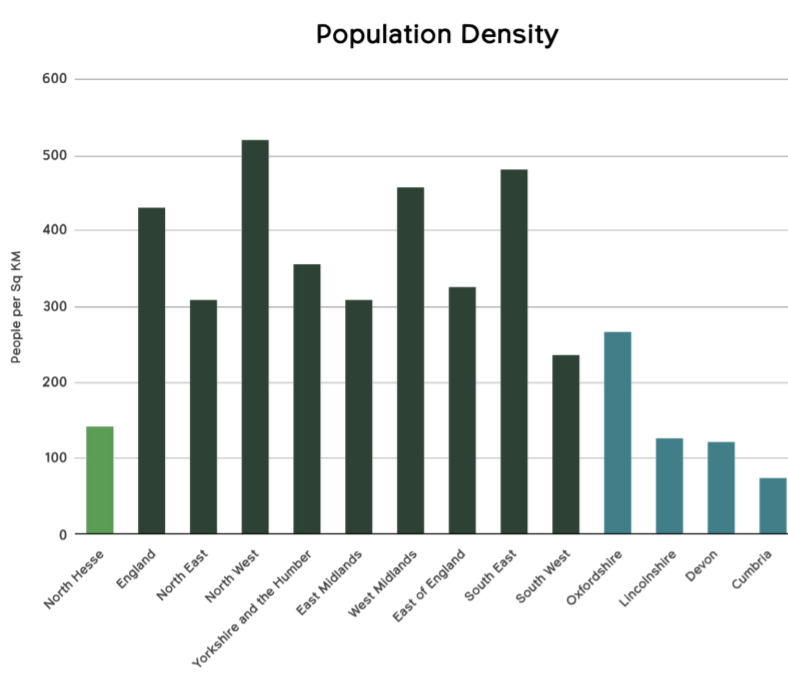
As the figure above shows, the North Hesse Verkehrsverbund delivers a bus service to every village, every hour across an area that is significantly less densely populated than many rural counties and regions of England. The North Hesse approach shows that sparsely populated dispersed communities can be incorporated into a comprehensive bus network that provides a genuine alternative to car ownership. So, England’s rural transport deserts are not caused by a law of nature. The examples of Bern, Zurich and North Hesse highlight many of the key elements that bus policy in this country will need to address if public transport is to become a genuine alternative to car ownership here. Our policy proposal is supported by a wide range of stakeholders, including the more than 51,000 people who have signed our petition for a reliable bus service for every community. The Association of British Commuters called our Every village, every hour vision the “bus strategy we’ve all been waiting for”, and the NFWI have echoed our call for the government to “guarantee a minimum frequency of bus services for towns and rural areas”.2
4. Implementation
4.1 Costs
Our ground-breaking modelling finds that the government could deliver a bus to every village, every hour across England from 6am to midnight, 7 days per week, for £2.7 billion annually.
4.2 Potential savings include:
- Using buses rather than private cars reduces air pollution3 – current cost to the UK £23 billion per year.4
- Using buses rather than private cars reduces the tyre wear that generates 68,000 tonnes of microplastic pollution every year5 – contributing to costs of up to £500 million every year in just on region of our coastal economy.6
- Buses can carry enough passengers to take up to 75 cars off the road,7 tackling congestion – current cost to the UK £12 billion per year.8
- Bus services are essential for reducing road traffic, which emitted 110.7 million tonnes of carbon dioxide in the UK in 2019 – estimated current economic cost is £6.5 billion per year, with further long-term impacts.9
- Walking to and from bus stops rather than taking door-to-door car journeys can significantly reduce the crisis of physical inactivity – current cost to the UK £7.4 billion per year.10
4.3 Further information
The full policy report, the modelling with tables, and the methodology that lies behind it can be found here.
- https://www.cpre.org.uk/wp-content/uploads/2020/02/CfBT-Transport-Deserts-Feb-2020-web-spreads.pdf
- https://www.thewi.org.uk/__data/assets/pdf_file/0007/534562/WI_A_New_Route.pdf
- Greener Journeys (2017) Tackling pollution and congestion.
- Transport for Quality of Life (2018) More than electric cars.
- Eunomia (2018) Reducing household contributions to marine plastic pollution.
- MICRO Interreg project IVa. (2014) Socio-economic impact of microplastics in the 2 Seas, Channel, and France Manche Region: an initial risk assessment.
- Greener Journeys (2017) Tackling pollution and congestion.
- CIHT (2019) Better planning, better transport, better places.
- https://www.gov.uk/government/statistics/final-uk-greenhouse-gas-emissions-national-statistics-1990-to-2019 Table 1.2 shows that total road transport emissions in 2019 were 110.7 MtCO2e. Taking the government’s 2019 central non-traded value of £59 per tCO2e gives the estimated cost of £6.53 billion for road transport carbon emissions in 2019. Accessed 25.02.2021.
- Transport for Quality of Life (2019) Segregated cycleways and e-bikes – the future of urban travel.